Why Dealership Software Built Before 2023 Can't Be Retrofitted for AI
Every legacy DMS vendor is now running an "AI-powered" campaign. Chatbots bolted onto CRM modules. A recommendation widget dropped into the inventory screen. A dashboard that says "insights" in the header. None of it changes how the system actually works underneath — and that gap is exactly why so many of these upgrades fail to move the numbers dealers care about.
There's a real difference between software that has AI features and software that is AI-native. Dealerships are starting to feel that difference, and it's reshaping what they look for in the best automotive dealership management system. Vehicron was built to answer that shift directly.
The Architecture Problem Nobody Talks About
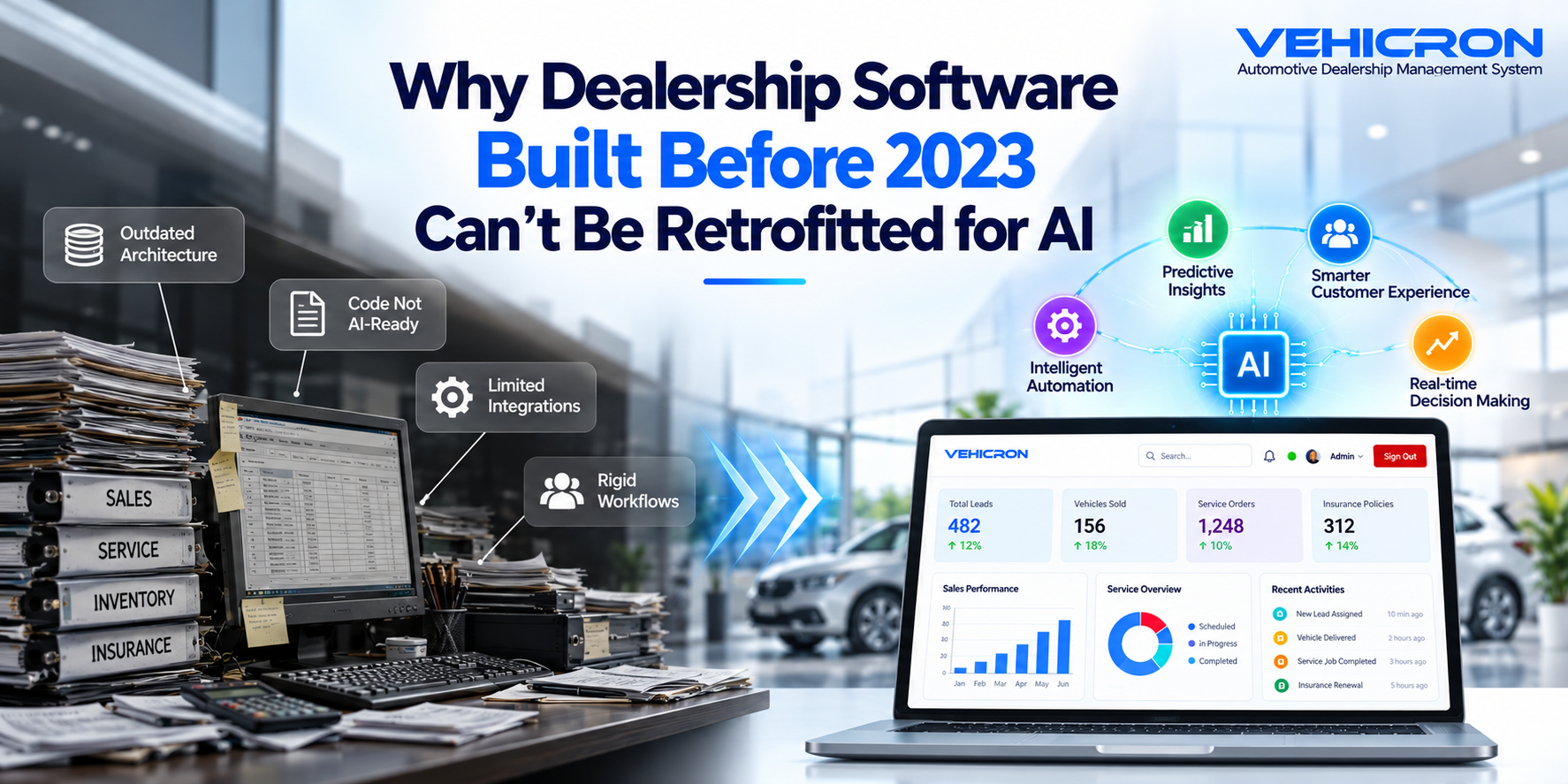
A DMS built in 2015, or even 2021, was designed around a simple assumption: a human being will look at a screen, read some data, and make a decision. Every workflow — from lead assignment to stock allocation to service scheduling — was built for that loop. Data lived in siloed tables optimized for that one screen's query, not for a model that needs to reason across modules in real time.
Retrofitting AI onto that foundation means bolting a prediction engine onto data structures that were never meant to feed one. The result is AI that can summarize what already happened, but struggles to predict what should happen next — because the underlying data was never unified enough to support that kind of reasoning.
This is why so many "AI upgrades" on legacy platforms feel hollow. They can write a follow-up email. They can't tell you which of your 40 vehicles in stockyard is about to become a margin problem.
What AI-Native Actually Requires — and How Vehicron Was Built
An AI-native dealership management system is architected differently from day one. Vehicron's 14 modules were designed around these principles from the start, not added on later:
Unified data layer. Inventory, CRM, accounting, service, and fuel data live in one connected model — not five databases stitched together with APIs and nightly syncs. Vehicron's Stockyard, CRM, Accounting, and Service & Bodyshop modules share one data core, so a signal in one module is visible everywhere else instantly.
Real-time signal, not batch reporting. Legacy systems often refresh dashboards overnight. Vehicron reads and acts on signals as they happen — a vehicle sitting too long in Stockyard, a lead going cold in CRM, a service bay running under capacity — flagged the moment they occur, not the next morning.
Workflow-embedded intelligence, not a separate tool. Vehicron doesn't send dealers to a different tab to "check AI insights." The intelligence sits inside the workflow itself — flagging the stuck vehicle right there in Stockyard, not in a report someone has to remember to open.
Designed for prediction, not just recording. Legacy DMS platforms were built to log what happened. Vehicron was built to model what's likely to happen — inventory turn probability, lead conversion likelihood, service bay bottlenecks — because its data structure was designed to support that kind of forward-looking model from day one.
The Cost of Retrofitting
Dealers evaluating a legacy platform's "new AI module" should ask one question: does this feature see the same data as every other module in the system? In most cases, the honest answer is no. The AI feature runs on a parallel data pipeline, disconnected from the CRM, the accounting ledger, and the stockyard. It can produce a chatbot reply. It cannot tell a sales manager that the customer on the phone already has an unresolved service complaint from three months ago, because that information lives in a different module the AI was never connected to.
That disconnect isn't a minor technical detail — it's the difference between a system that answers questions and one that actually runs a dealership's operations smarter. Dealers on Vehicron report the difference immediately: faster vehicle turnaround, fewer manual handoffs between departments, and visibility into problems before they become expensive ones — reflected in Vehicron's own numbers, including 40% faster delivery and 100% movement visibility across live dealer accounts.
What This Means for Dealerships Evaluating a DMS in 2026
The dealership software market is at an inflection point similar to what CRM software went through a decade ago, when cloud-native platforms outpaced retrofitted on-premise systems almost overnight. The same shift is happening now with AI. A platform's age isn't the issue — plenty of newer platforms are still built the old way. The real question is architectural: was this system designed around a unified, predictive data model from the start, or is the AI a layer added on top of a structure that predates it?
For dealerships comparing options, that question matters more than any individual feature list. The best automotive dealership management system in 2026 isn't the one with the longest list of AI buzzwords — it's the one where every module, from Used Cars to Accounting to Test Drive, feeds a single intelligent core that gets smarter the more the dealership uses it. That's the architecture Vehicron was built on from day one — not retrofitted, native.
FAQs
What makes a dealership management system "AI-native" instead of just "AI-powered"?
An AI-native DMS like Vehicron is built on a unified data architecture from the start, so AI can reason across every module — CRM, inventory, accounting, service — in real time. An "AI-powered" system usually means AI features were added on top of an older, siloed database structure, which limits what the AI can actually see and predict.
Can a legacy DMS be upgraded to become AI-native?
Technically, yes, but it typically requires rebuilding the core data architecture, not just adding a feature. Most vendors instead layer AI tools on top of the existing structure, which is why those upgrades tend to handle simple tasks well but struggle with cross-module predictions.
Does Vehicron's AI-native architecture require extra setup or integration work for dealers?
No. Because Vehicron's 14 modules already share one unified data core, dealers get AI-driven insights — like Stockyard aging alerts or CRM lead-scoring — without needing separate integrations or manual data syncing.
How does an AI-native DMS actually improve day-to-day dealership operations?
It surfaces problems before they become expensive — a vehicle sitting too long in Stockyard, a service bay nearing capacity, a lead going cold — directly inside the workflow the team is already using, instead of in a separate report someone has to check.
Is Vehicron suitable for dealerships still using spreadsheets or an older DMS?
Yes. Vehicron is designed to replace both spreadsheet-based tracking and legacy DMS platforms, with onboarding support to migrate existing inventory, CRM, and accounting data into its unified system.


